Receiving, washing and preparation
Fruit is transferred to the washing section without allowing receiving debris to accumulate at the clean preparation area. A brush bed with spray water cleans the external surface; inspection and the chosen crown, shell, core and cutting operations follow the material route. Prepared fractions supplied by another operation enter at a different point and need their own receiving arrangement.
The preparation conveyor presents material to operators and carries it to the crusher feed. The crusher reduces that feed into mash. Its motor rating and generic fruit capacity do not establish the rate at which the next machine can drain and press pineapple.
Pressing and finishing
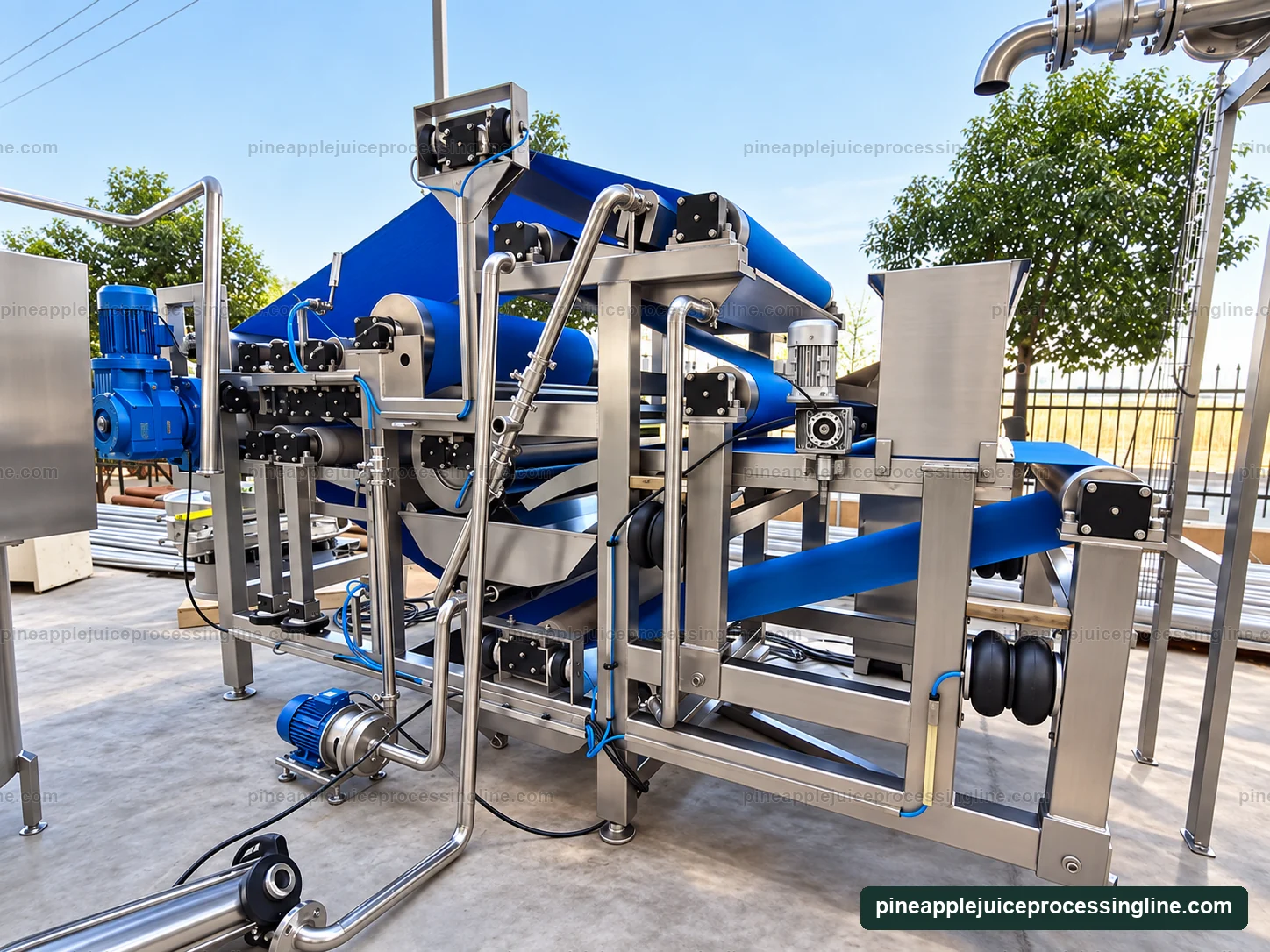
The belt press spreads the mash and progressively applies the mechanical separation duty. Collected juice passes to the selected finishing arrangement; the cake leaves as a separate material stream. A finisher removes coarse fibre and other retained solids through screened separation.
Cloudy juice finishing and clear juice production diverge here. A controlled fine pulp fraction can remain in a cloudy product. Additional membrane clarification instead separates a permeate stream from retained material and changes the solids balance. Neither route should be assumed solely from the word juice.
Juice and concentrate take different downstream paths
The sequence around deaeration, heating and concentration follows the engineered product route. Ordinary buffer vessels belong outside a controlled sterile downstream path unless specifically designed and integrated for that duty.
| Section | Juice route | Concentrate route |
|---|---|---|
| Buffer and transfer | Connect extraction to the treatment rate | Provide a steady evaporator feed |
| Vacuum treatment | Selected deaeration where the product requires it | Selected deaeration plus evaporation vacuum duties |
| Water removal | No concentration step | Evaporator with matched heating and condensing services |
| Final processing | Thermal treatment, cooling and packaging for the intended juice | Concentrate transfer, final treatment and matched packaging |
Cleaning and services complete the flow
Open fruit and extraction equipment needs washing access, collected drainage and space to remove screens or guards safely. Suitable closed tanks, pipework and thermal circuits connect to a CIP supply and return. Membrane cleaning and aseptic filling have their own equipment-compatible procedures.
Water, electrical power, heating, cooling, vacuum and compressed air are assigned to the actual machines that use them. Interlocks connect the process sections so a downstream stop does not continue filling an upstream collection vessel or spilling mash onto a stopped belt.