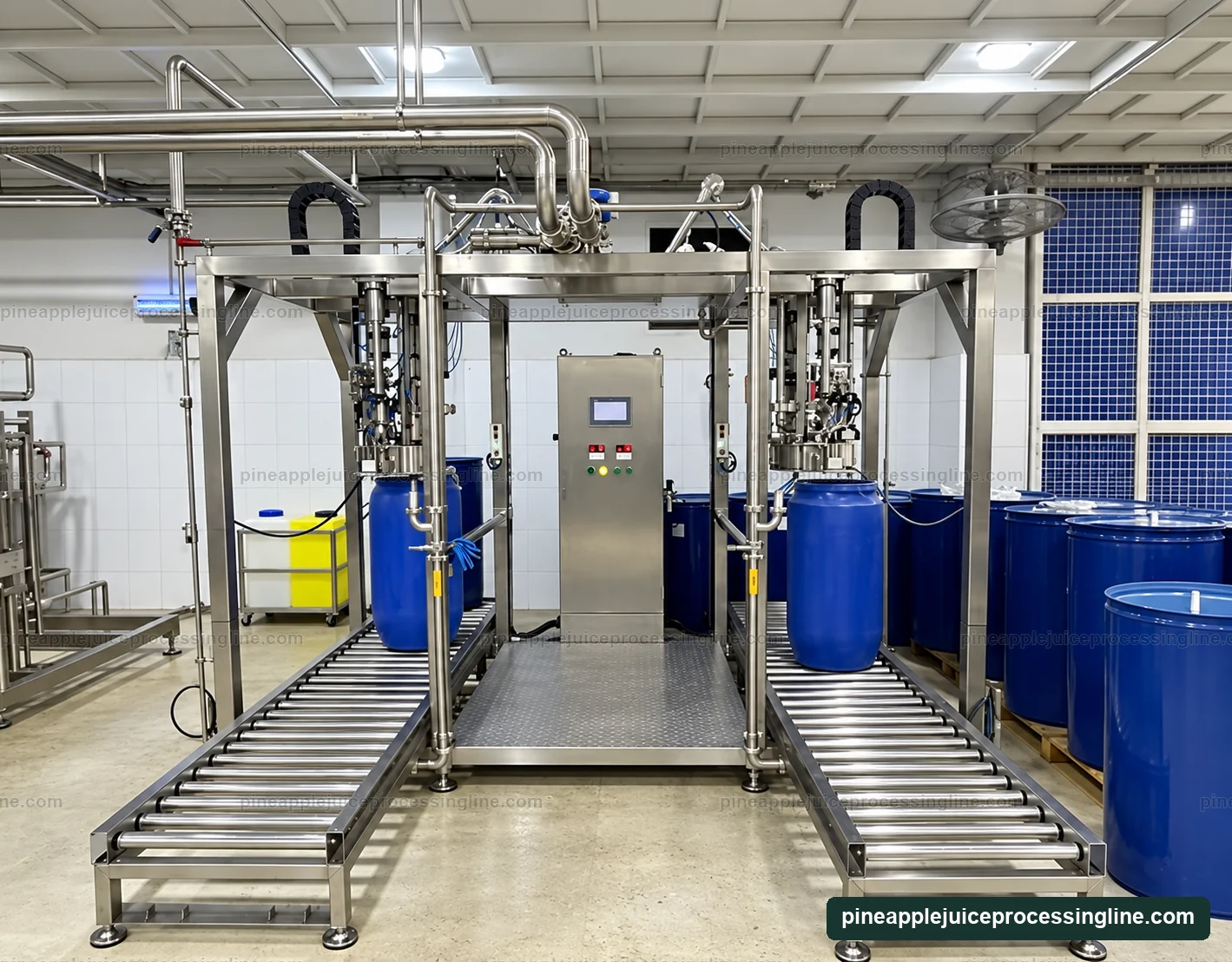
Describe the product at the filler inlet
Identify whether the product is juice or concentrate, its operating temperature, flow and pulp behaviour. Product transfer and buffering must match those conditions as well as the upstream treatment sequence.
The filler is not itself proof of a validated preservation process. Thermal treatment, sterile transfer and the selected package are assessed as a connected product route.
Include the complete bag-handling cycle
Specify the intended package and fitment with the filling-equipment discussion. Bag presentation, connection, filling, disconnection and onward handling all contribute to the operating cycle.
Upstream equipment needs a defined response to bag changes and interruptions. Discuss working buffer volume and control signals so those events do not become uncontrolled product-handling problems.
Define the treatment, cleaning and supply boundary
Identify the product-treatment system, transfer pipework and services available at the site. Cleaning and operating procedures must be compatible with the selected equipment and packaging arrangement.
For an initial enquiry, provide the product type, intended package and upstream treatment scope. Any claimed shelf life or sterile performance requires its own product and process validation.
At this stage
Practical questions
Can the filler be connected directly to an untreated juice tank?
An aseptic route requires compatible product treatment and a controlled sterile product connection. Define that complete route rather than selecting a filler in isolation.
Does a filler model establish product shelf life?
No. Shelf life depends on the validated product, treatment, sterile handling and package, not simply an equipment name.