Establish the complete product path
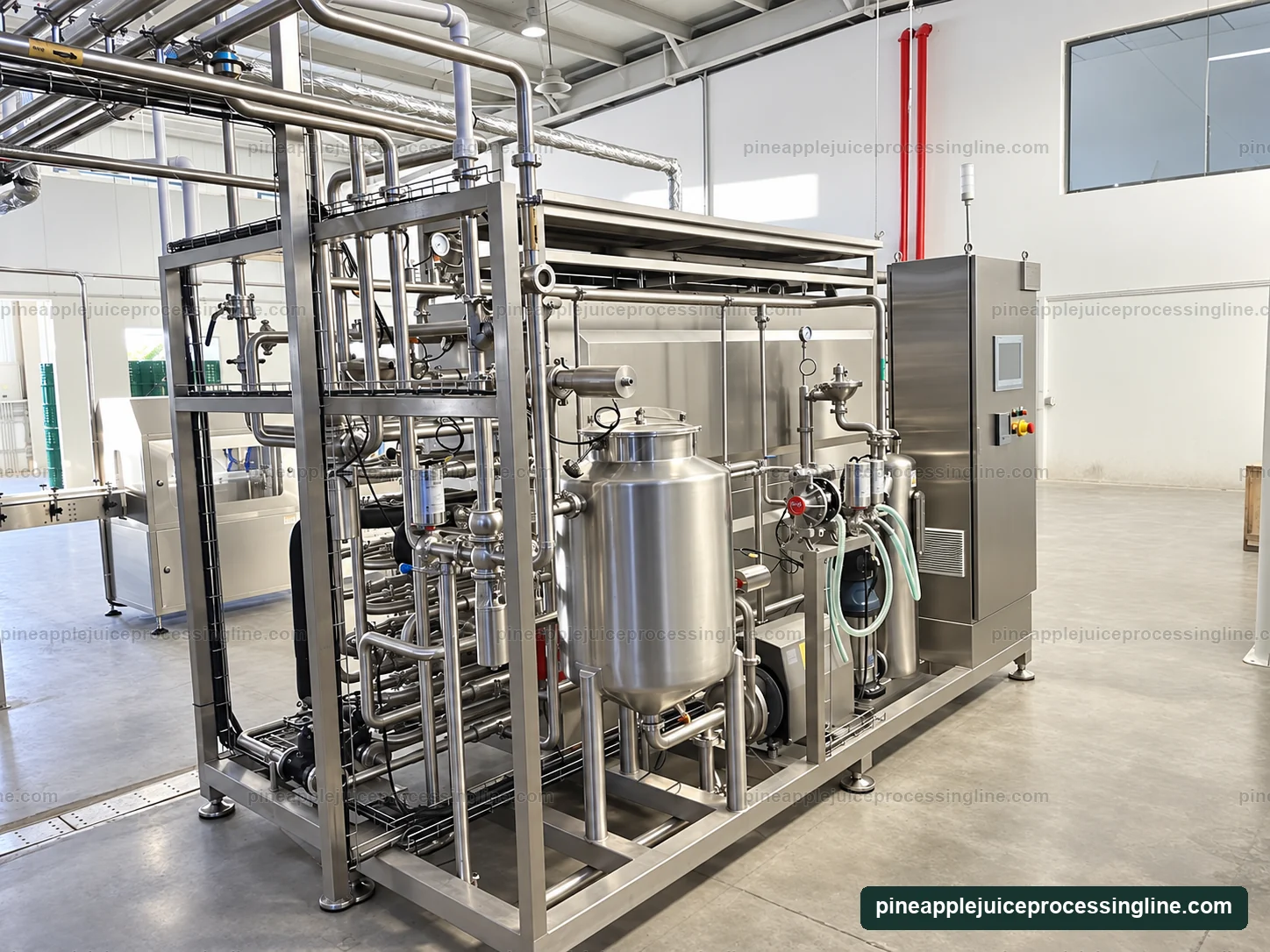
The selected process drawing identifies the heat-exchange sections, holding path, measurement locations and outlet connection. The skid provides the pipework, vessels, pumps and controls required by that arrangement.
For pineapple juice, consider pulp and fibre as well as soluble solids. Concentrated and single-strength streams need their own flow and pressure assessment. The exterior of a tubular system does not define the internal passage available to a particular product.
Catalogue family configuration envelope
The family references cover configured duties and are not a promise that every combination is available on one unit. The required process is established for the product formulation, properties, package and storage conditions.
| Item | Family reference | How to apply it |
|---|---|---|
| Process temperature | 72–150 °C | An equipment-family range, not a pineapple treatment schedule |
| Holding time | 15–120 s | Established with the chosen flow and holding arrangement |
| Heating service | Hot water or steam | Matched to the selected heat duty |
| Cooling service | Cooling water or chilled water | Matched to the required outlet condition |
| Product-contact material | SUS304 or SUS316L options | Agreed for the product, cleaning conditions and equipment scope |
Define what happens outside the intended treatment condition
Control should address the product flow and the treatment measurements together. Specify the operating window, records and the action taken when the agreed conditions are not met.
Include startup, changeover and shutdown in the routing design. Any return or diversion function must be identified in the selected control sequence so that off-condition liquid is handled through the intended route.
Carry the required condition through to filling
For an aseptic-bag route, the treatment outlet and the sterile transfer and filling boundary must be specified as one connected process. Agree preparation, interruption handling and the conditions required to resume production.
A different package may call for a different outlet temperature or preservation approach. Neither a catalogue temperature range nor the name of a filler establishes the shelf life of the finished juice.
Include deposits and pressure change in the cleaning plan
Follow the product through heating surfaces, holding pipework, pumps and valves when defining the cleaning circuit. Product deposits can alter heat transfer and pressure drop during a run, so the procedure and operating checks need to reflect the actual feed.
Provide suitable access for seals, instruments and selected removable components. The CIP supply, return and drains should serve the whole defined route, with the required checks before the next product run.
At this stage
Practical questions
Can the same thermal setting be used for juice and concentrate?
They need separate assessment of product properties, flow, treatment and packaging. Hardware adjustability does not establish that one temperature and holding time meets both processes.