Arrange the wet front end and juice section around real access
Position receiving, washing and preparation so drainage and rejected material move away from exposed prepared fruit. The crusher inlet must be reachable through its intended feeding arrangement, while the press needs access along the belts, rollers and collection area. Pomace containers or removal equipment should not obstruct the clean liquid-transfer route.
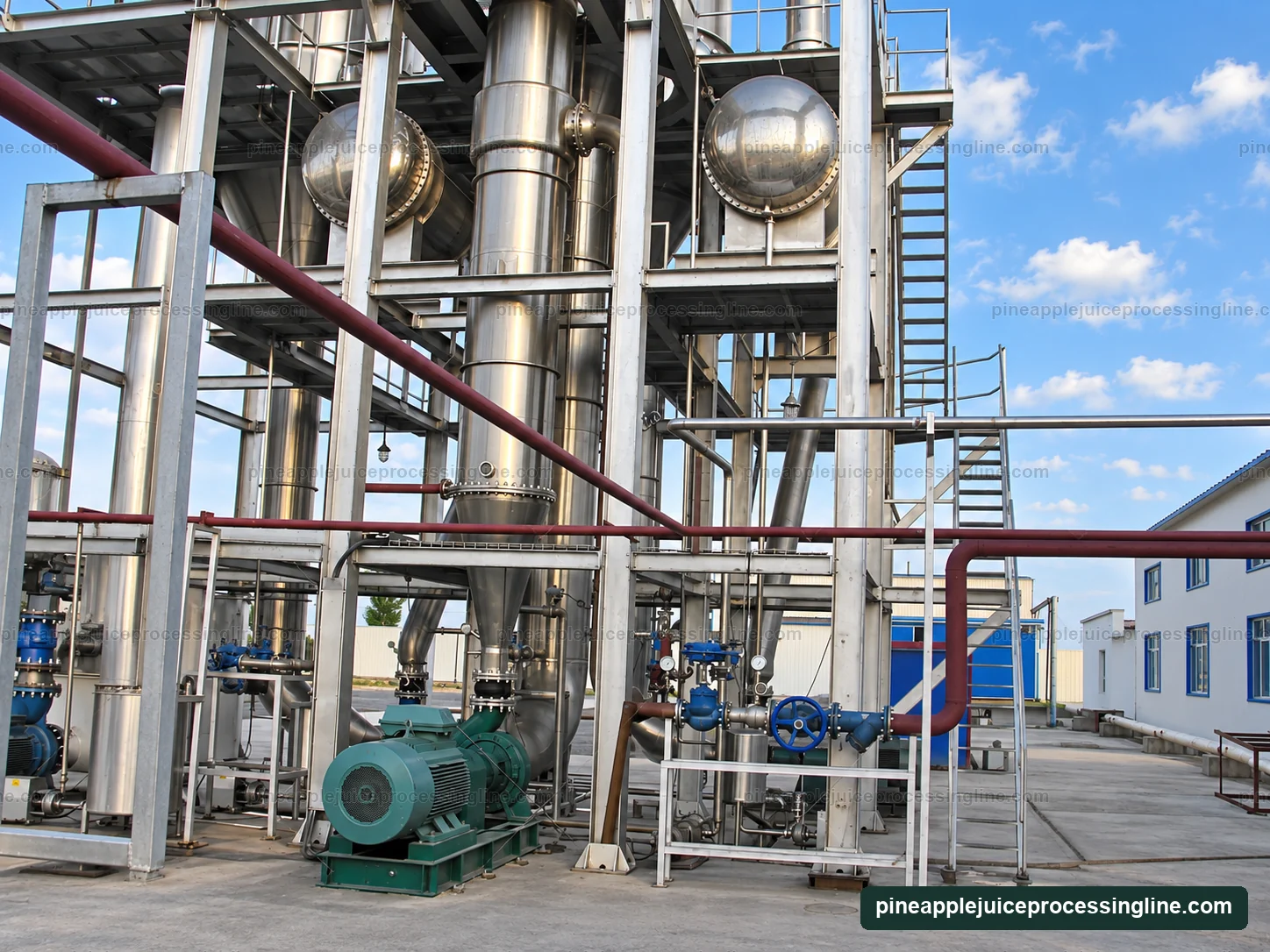
Leave removal space for crusher covers, finisher screens, pump assemblies and service components. Tall evaporation equipment also needs installation height and access to platforms and connections. A plan that fits the machine footprint but blocks its removable parts is incomplete.
Balance flow and give stops a controlled outcome
The press feed rate follows the mash it can distribute and separate. A downstream collection vessel or buffer smooths short disturbances before liquid treatment. Its working volume is derived from the actual liquid flow and the duration of the interruption to be covered, with usable level limits and cleaning needs included.
Control permissions should prevent feeding a stopped crusher or press, running a transfer pump without a suitable supply, and overflowing a receiving tank when a later section stops. Thermal processing and aseptic filling add their own process-state and diversion requirements. These controls are selected around the installed equipment and validated during commissioning.
Operating information should distinguish production, circulation, waiting, cleaning and fault states. A nominal motor-running signal alone does not prove that product is flowing through the intended path.
Assign each service to a defined connection
Service demand is calculated from the selected machines and operating cases. Production, start-up and cleaning may create different peaks. Site supply equipment and distribution pipework are identified separately from what is included on a machine skid.
| Service | Main users | Engineering boundary |
|---|---|---|
| Water and drainage | Washer, open cleaning and selected process services | Water quality, distribution, collection and drain capacity |
| Electrical power | Drives, pumps and control equipment | Connected loads, supply and motor/control interfaces |
| Heating and cooling | Thermal processing, evaporation and selected CIP duties | Available medium, supply condition, return and demand |
| Vacuum and condensing | Deaeration and evaporation | Selected package, cooling interface and vent/condensate handling |
| Compressed air | Selected actuators, controls and filling equipment | Required quality, pressure and point-of-use connections |
Trace operating symptoms to the right section
These checks help locate a process issue; they are not instructions to bypass guards, force valves or alter a validated thermal process. Isolate machinery before opening or clearing it and follow the installed equipment procedures. Repeated symptoms should be assessed across adjacent sections instead of raising the speed of one machine in isolation.
| Observation | Checks at the relevant equipment | Useful record |
|---|---|---|
| Mash piles up or escapes at the press inlet | Upstream feed rate, distribution, belt movement and downstream readiness | Prepared-feed condition and rate when the accumulation began |
| Juice collection backs up | Drain path, receiving level, pump condition and outlet restriction | Collection level, pump state and downstream pressure |
| Juice has an unexpected coarse fraction | Preparation changes, screen condition, seating and selected finishing route | Feed fractions, screen identification and paired product samples |
| Transfer is intermittent or foamy | Receiving level, suction path, air entry and pump operating condition | Tank level, temperature and flow behaviour |
| Concentration drifts | Feed solids and rate, heating, vacuum, distribution and discharge conditions | Matched feed and concentrate samples with operating readings |
| Frequent stops occur at filling | Bag-handling cycle, product supply and equipment status | Complete fill-cycle times and cause of each stop |
Commission the connections as well as the machines
Mechanical checks cover equipment identification, connections, guards, access and drainage. Functional checks follow the intended operating sequence, level controls, stop responses and cleaning paths. Product runs then relate actual feed and output to the agreed test conditions.
The acceptance plan states the material, run duration, measurements, sampling points and included downstream equipment. A water circulation check can demonstrate a connection or control function, but it does not establish pineapple recovery, fouling behaviour or final product shelf life.