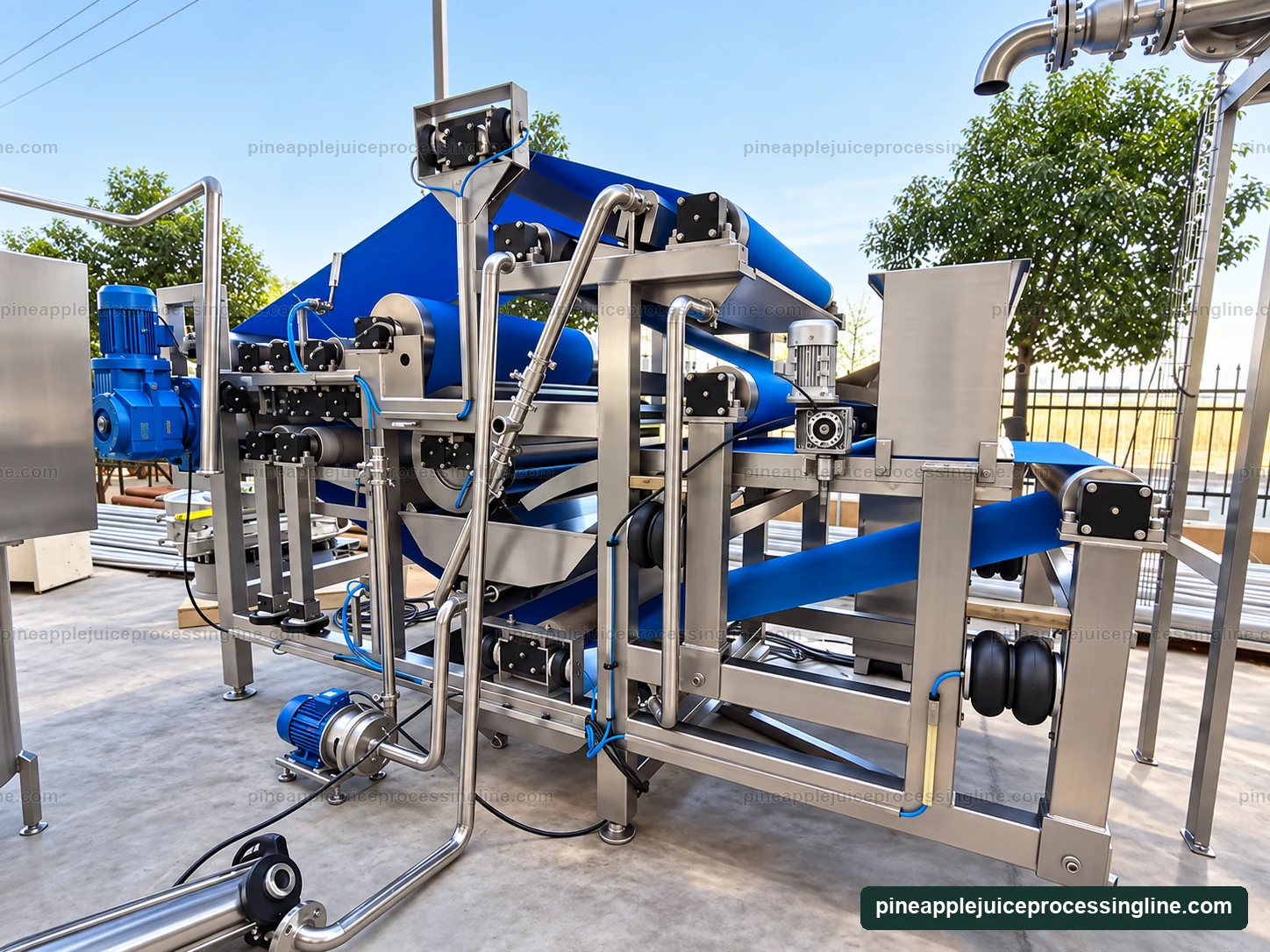
Drain and press the moving material layer
Prepared mash is distributed onto the belt and carried through the pressing path. The filter belt permits juice drainage as the roller arrangement applies pressure to the moving material. Belts, rollers, drives and the collection system operate as one extraction machine.
The open structure makes the belt path and much of the working arrangement accessible for inspection. The installation view shows the actual blue belts, stainless supports, drives and connecting pipework. Space around those components matters for cleaning, belt service and removal of retained fibre.
Match the press to the crusher discharge
Material form controls how a press operates. Evaluate the prepared pineapple feed for its fibre, liquid release and ability to spread into a consistent layer. Belt loading and the selected operating adjustments should work with that material rather than compensate for an unsuitable upstream preparation.
A representative trial records incoming mash, collected juice, pomace and any additional streams on a common time basis. Compare juice quality and solids carryover alongside recovery. A fixed percentage cannot describe every fruit supply or preparation route.
Provide working routes for both juice and pomace
| Press interface | Arrangement to include |
|---|---|
| Mash inlet | Feed delivery and distribution across the selected working width |
| Juice collection | Collection, transfer and the next coarse-fibre separation stage |
| Pomace outlet | Continuous removal and container or conveyor access |
| Belt system | Tracking, tensioning and the selected operating adjustment method |
| Wash system | Belt-cleaning supply and a separate route for wash water and solids |
Keep the belt openings and collection surfaces accessible
Belt condition and cleaning influence drainage through the working surface. Include access to rollers, belt returns, scrapers where fitted, collection pans and the areas below the press. The selected wash arrangement must carry removed residues away from the product collection route.
Confirm the belt replacement method, wear-part access, guarding and isolation procedure. This is an open extraction machine with mechanical cleaning needs; a closed-circuit CIP station elsewhere in the line does not make every press surface automatically cleanable in place.
Send the expressed juice to the required finishing route
The press separates bulk liquid from pomace, but the juice may still need screening to establish the required coarse-fibre and pulp content. Fine clarification is an additional product choice rather than a default consequence of pressing.
The chosen buffer, transfer and treatment equipment should be sized from the recovered juice stream under its actual conditions. The press feed in tonnes per hour and the downstream juice flow in litres per hour require separate values in the line balance.
At this stage
Practical questions
What does a useful pineapple pressing trial establish?
It relates the prepared-feed condition and mass to collected juice and pomace, while checking juice quality, solids carryover and stable belt operation. The result belongs to those fruit and machine conditions, rather than becoming a universal yield claim.