Compare the three scopes
| Purchase | Starting point | Main equipment | Output interface |
|---|---|---|---|
| Fresh-fruit juice line | Incoming pineapple | Washing and preparation, crusher, press, finisher, liquid treatment and selected filling | The selected bulk juice package |
| Juice concentrate section | Existing or integrated extracted juice | Feed buffer, selected finishing, evaporator, concentrate transfer and downstream treatment | Concentrate at the agreed handling or filling connection |
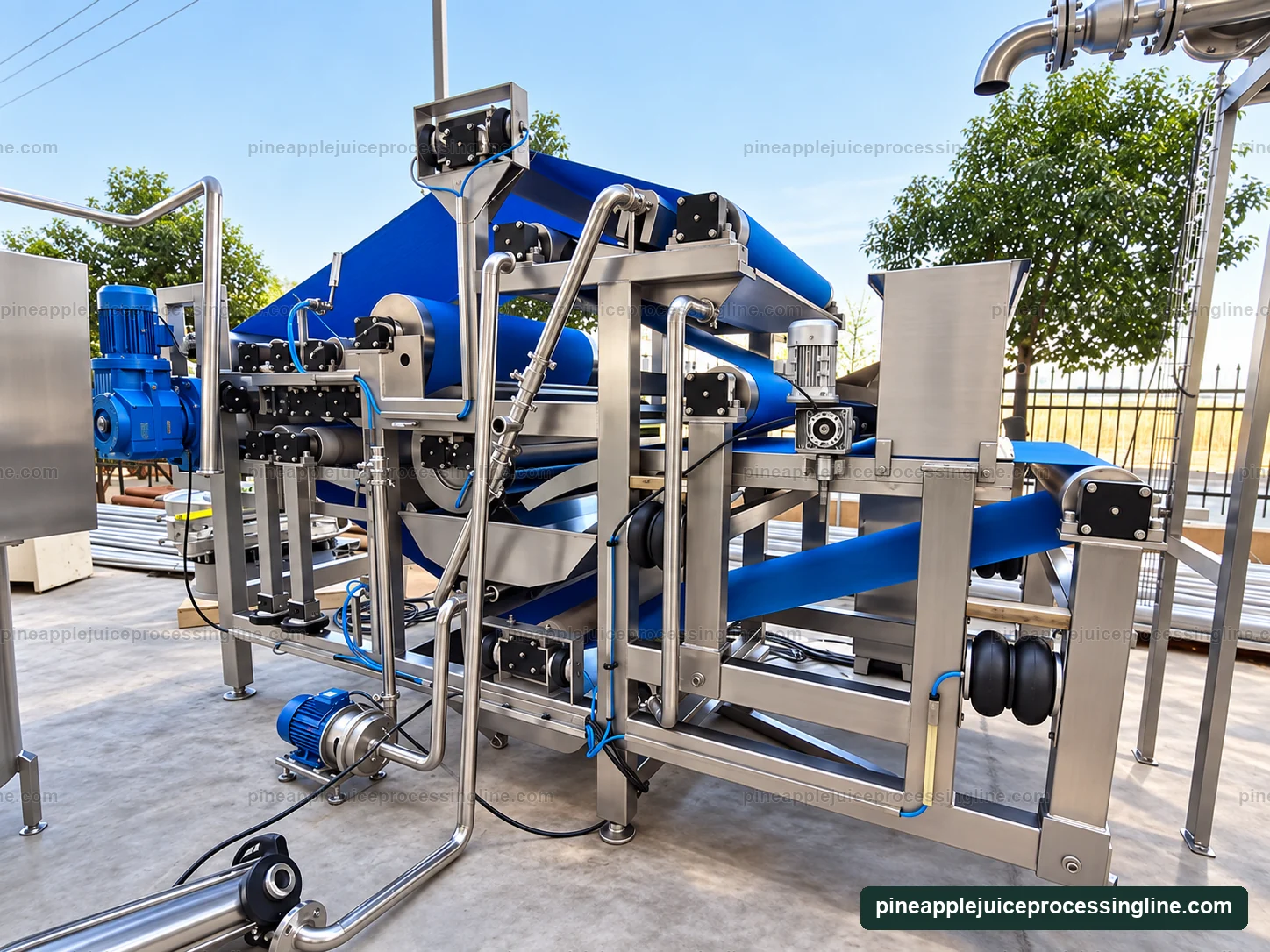
| Extraction module | Prepared fruit from an existing operation | Crusher, belt press, collection and selected finisher | Juice to existing treatment, with separate pomace discharge |
Product choices do not all require another complete line
Cloudy and clear juice have different solids-handling requirements. A screen finisher controls coarse fibre; tubular ultrafiltration adds a distinct fine-clarification duty and a retained stream. The decision affects product character, recovery accounting, cleaning and the feed condition for later equipment.
Concentration adds water-removal equipment and utility demand. Bulk packaging adds its own thermal, sterile-transfer and filling interfaces. These choices can be combined with the appropriate extraction scope, but their capacities and operating conditions should remain separate in the equipment schedule.
Compare quotations on the same capacity basis
A fruit crusher rating usually describes a material feed duty. The liquid-treatment section handles the juice that extraction actually recovers. An evaporator is selected around water removal, while a filler also spends time connecting bags and handling completed packs. Numbers with different denominators cannot establish a balanced line.
A useful equipment schedule states the material at each inlet, the chosen machine or configuration, the intended working range and its connection to adjacent equipment. For extraction, representative feed trials link crusher and press settings to juice and pomace measurements. For thermal and aseptic equipment, product and package requirements determine the process and acceptance conditions.
Read the equipment boundary as carefully as the machine list
A first enquiry can be short: the equipment section and intended product are enough to begin. Existing inlet material, a rough production requirement and the desired package help narrow the configuration without requiring a complete engineering specification at first contact.
- Identify the actual machines, product-contact configuration and selected accessories, including feed distribution and juice collection around the press.
- Locate each connection to existing conveyors, tanks, pumps, utilities, drains and controls.
- Separate open-equipment cleaning provisions from closed CIP circuits and sterile-system requirements.
- Include installation access, lifting and positioning needs, operator access and removable-part clearance in the layout.
- State which documentation, inspection, commissioning, training and spare-part items are included in the delivery scope.
At this stage
Practical questions
Can I buy only a crusher or a press?
Yes. The equipment catalogue has separate crusher and belt-press pages, and the extraction module connects those machines for an existing preparation operation. The inlet, outlet and control connections define the individual supply.
Is a screen finisher another type of juice press?
No. The press separates liquid from prepared mash by drainage and mechanical pressure. The finisher uses screened separation to control the coarse material in the extracted stream. They perform different jobs in the line.
Does a clear-juice order automatically include ultrafiltration?
Clear juice requires an agreed clarification result, but the chosen process depends on the feed and product. Tubular ultrafiltration is one available equipment route. Its membrane, retained stream and cleaning duty must match that application.
Can one quoted t/h value describe the whole plant?
Only if the material and measurement location are stated. Incoming fruit, prepared mash and recovered juice are different streams. Evaporated water and filled concentrate introduce further capacity bases.
Is there a standard pineapple juice yield?
Recovery varies with fruit condition, preparation, included fractions and extraction settings. A meaningful figure states whether its denominator is incoming fruit or prepared feed, and records juice, pomace and other outlets over the same interval.
Does the preparation conveyor automatically peel or core fruit?
The conveyor supports inspection, handling and manual preparation work. Cutting operations and any separate preparation machinery are selected for the actual route; they are not implied by the conveyor name.
Can an existing juice plant add concentration later?
An evaporation section can connect to an existing juice supply when feed quality, flow, buffering, utilities and downstream handling are matched. It does not require purchasing a second washing and extraction section.
Can every machine share one CIP cycle?
No. Closed product circuits may use CIP, while press belts, washer brushes and accessible screens need their own cleaning and inspection methods. Membranes and aseptic equipment also have equipment-specific limits and procedures.