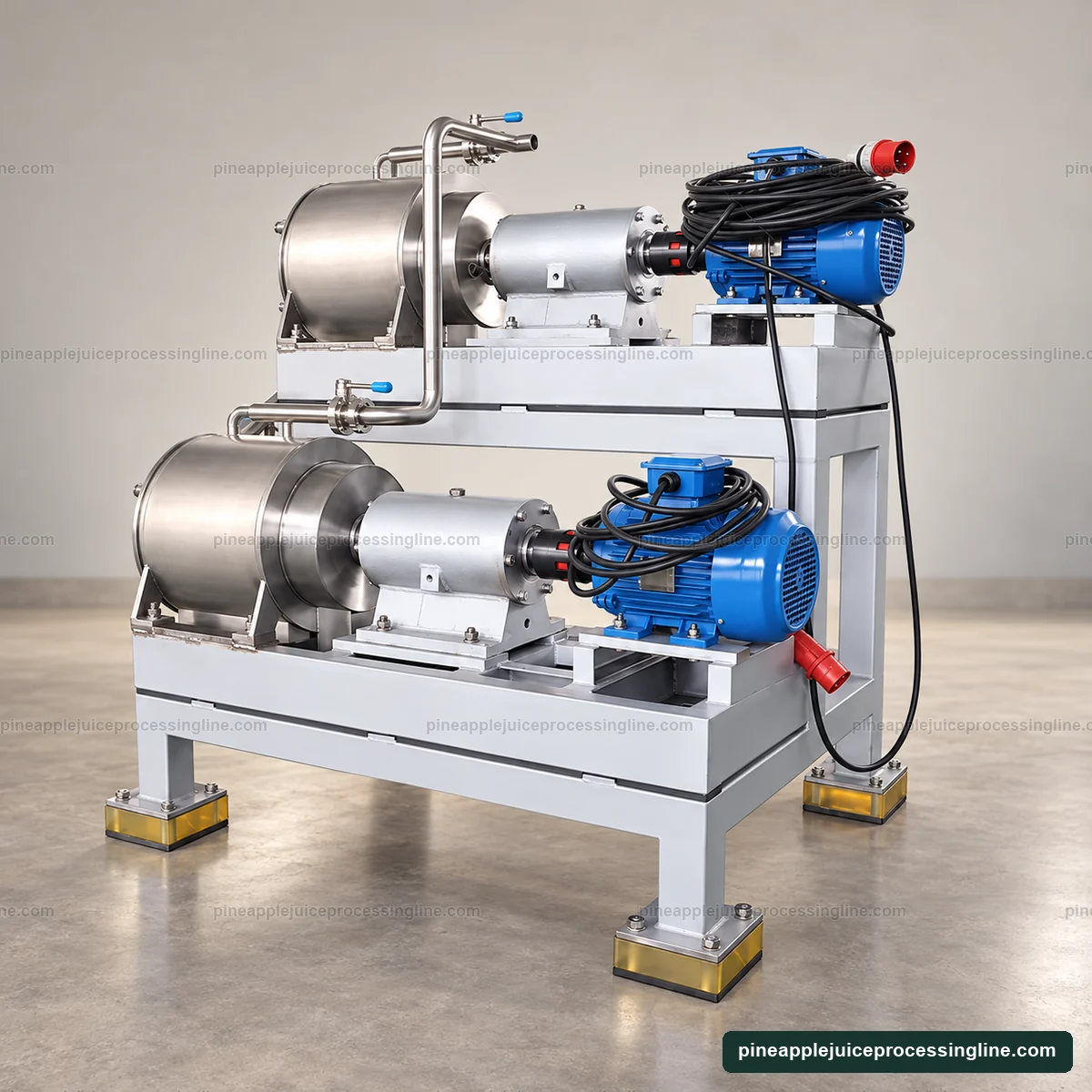
Start with the product objective
A cloudy product can retain an agreed fine-pulp fraction after coarse-fibre removal. A clarified product requires a further quality target that a screened outlet alone does not establish.
The finisher uses working screens and driven components. Tubular ultrafiltration uses a membrane circuit with permeate and retained streams. Their equipment, operating conditions and cleaning tasks are distinct.
| Decision | Screen finishing | Tubular ultrafiltration |
|---|---|---|
| Main duty | Coarse-fibre removal | Assessed clarification duty |
| Feed basis | Extracted juice and fibre | Defined prefinished juice |
| Operating focus | Screen loading and retained material | Membrane behaviour and retained stream |
| Cleaning | Screen and chamber access | Compatible membrane cleaning circuit |
Use a representative feed to set the specification
Agree the required product character and assess the feed under the intended operating conditions. Screen arrangement and membrane specifications should follow that discussion rather than be inferred from a general catalogue photograph.
For membranes, product-dependent flux, recovery, retained-material handling and cleaning behaviour require trials. For the finisher, assess loading, screened product and physical cleaning access.
Include the complete separation interface
Each option needs compatible feed buffering, transfer and a discharge route for separated material. Identify what is already available and what belongs in the new equipment supply.
An enquiry can begin with the intended cloudy or clarified product, approximate juice flow and current extraction arrangement. Add the existing sample or analysis when available.
At this stage
Practical questions
Are these alternative names for the same machine?
No. The screened mechanical assembly and the tubular membrane equipment have different construction, separation mechanisms and buying tasks.
Can either option be selected without a product target?
The required product character is an essential starting point. It determines the separation duty and the evidence needed to select operating conditions.