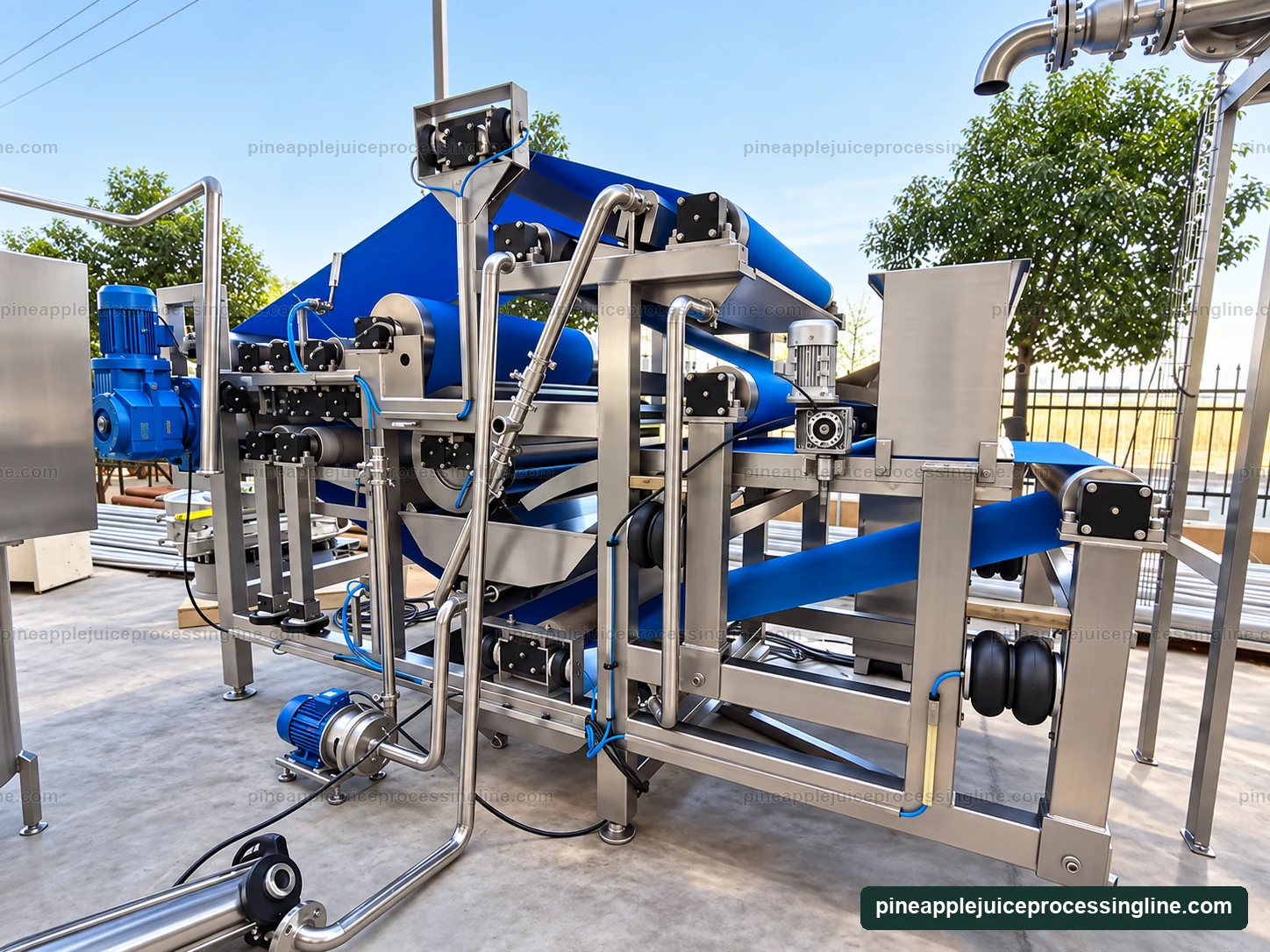
State the duty at each material boundary
Receiving and washing handle incoming fruit. The crusher and press handle the agreed prepared feed. Buffering, finishing, heat treatment and filling handle the recovered product stream.
Where concentration is included, calculate the water-removal duty from a defined juice flow and inlet and target solids. None of these quantities alone is a complete production capacity statement.
| Position | Quantity to define |
|---|---|
| Fruit intake | Incoming fruit mass and physical form |
| Press feed | Prepared mash mass and loading behaviour |
| Juice treatment | Recovered juice flow at stated conditions |
| Evaporation | Water removed from the defined feed |
| Filling | Product quantity and complete handling cycle |
Check the operating sequence, not only the nameplate
Short feed surges, bag changes or downstream stops can affect a connected line. Working buffer volume and controls should accommodate the agreed sequence rather than hide a persistent mismatch.
State the operating hours, cleaning windows and intended accumulation at each connection. An empty-machine demonstration does not establish performance with the selected pineapple material.
Use measured streams and representative trials
Where measurements are available, share the feed state, mass or volume, temperature and composition. Where they are not, identify which quantities need to be established during product or equipment trials.
This gives each machine a clear duty and makes the interfaces easier to compare. Keep generic model references separate from pineapple-specific demonstrated performance.
At this stage
Practical questions
Does tonnes of fruit per hour equal tonnes of juice per hour?
No. Preparation and extraction separate material. Use measured or agreed stream quantities at the relevant machine boundary.
Can tank volume fix an undersized extraction section?
A buffer can accommodate an agreed short variation, but it cannot indefinitely compensate for a persistent mismatch between production duties.