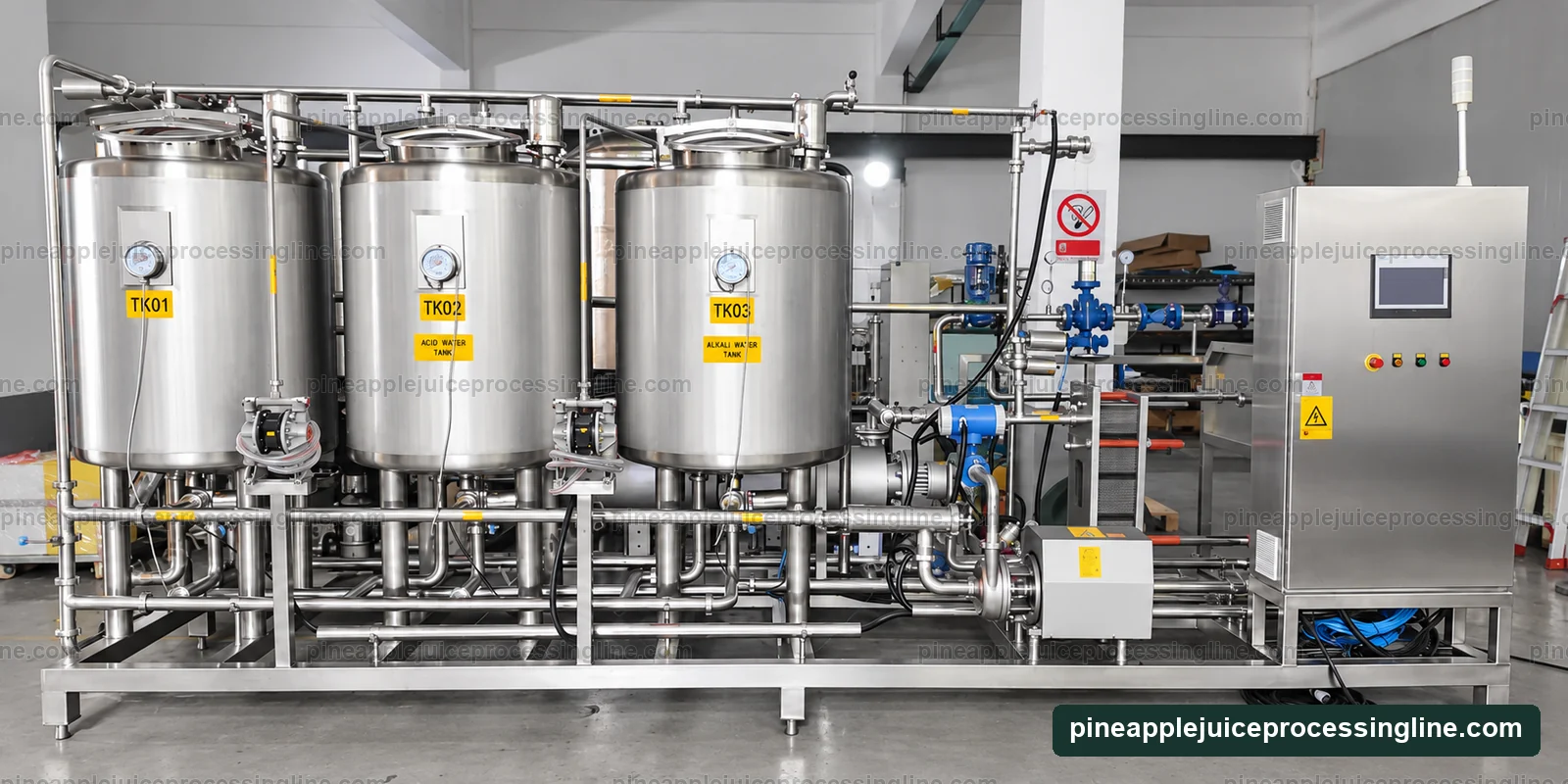
Allocate fluids and return routes deliberately
The supply circuit sends the chosen fluid through the connected equipment, while the return is routed for reuse or discharge according to the cleaning sequence. Valve positions and heating duty belong to that same operating plan.
Water, alkaline cleaning, acid cleaning and recovery are functions that may be configured in a system. They are not a tank-count specification. Establish the actual tank allocation and the conditions for recovering a return stream.
Give each process section an appropriate cleaning duty
| Equipment area | Cleaning consideration |
|---|---|
| Juice buffers and transfer | Pulp deposits, outlet drainage, branches and low points |
| Thermal and evaporation circuits | Heated deposits, return flow and heat-transfer surfaces |
| Tubular membranes | Membrane-specific chemical, temperature and pressure limits |
| Aseptic filling route | Cleaning and the separate procedure for establishing the required sterile condition |
| Open extraction equipment | Direct access and mechanical residue removal alongside any selected wash arrangement |
Assess the return from the circuit that is actually being cleaned
Pipe diameter, length, equipment internals and valve routing affect how a circuit receives cleaning fluid. Size the supply and return for the selected path, and identify the measurement points needed by the cleaning procedure.
Flow, temperature, chemistry and time work together. Return measurements such as temperature or conductivity may support the procedure, but an instrument reading at the station alone does not establish that every branch or concealed surface has been cleaned.
Keep belt and preparation cleaning visible in the operating plan
The brush washer, preparation conveyor, crusher access points and belt press have surfaces that need direct cleaning and inspection. Press belts, rollers and collection pans require their own access and residue-removal arrangement.
Define those duties beside the closed CIP circuits, with product isolation and a route for wash water and solids. They remain part of hygienic operation even when the downstream tanks and thermal system use an automated cleaning sequence.
Specify an operable sequence rather than a universal recipe
The installed equipment materials, residues and hygiene requirements determine the agreed cleaning procedure. Include chemical compatibility, drainage, inspection points and the checks required before returning to production.
The station also needs a practical utility and service plan: heating supply where used, water, electrical demand, chemical handling and wastewater routing. These connections should be included with the machine and circuit layout.
At this stage
Practical questions
Can the thermal-system cleaning programme be used for tubular membranes?
Only where it is compatible with the selected membrane, seals and operating limits. Define the membrane circuit and its procedure separately before sharing any cleaning supply.