Give clarification a defined feed
The belt press recovers juice from prepared mash, and the screened finisher removes coarse fibrous material. These stages establish the stream that the clarification equipment will receive. They do not guarantee optical clarity.
Identify the solids behaviour, temperature and variability of that stream. Feed buffering and transfer should avoid presenting the membrane section with uncontrolled changes that the agreed operating arrangement cannot accommodate.
Evaluate separation, retained solids and cleaning together
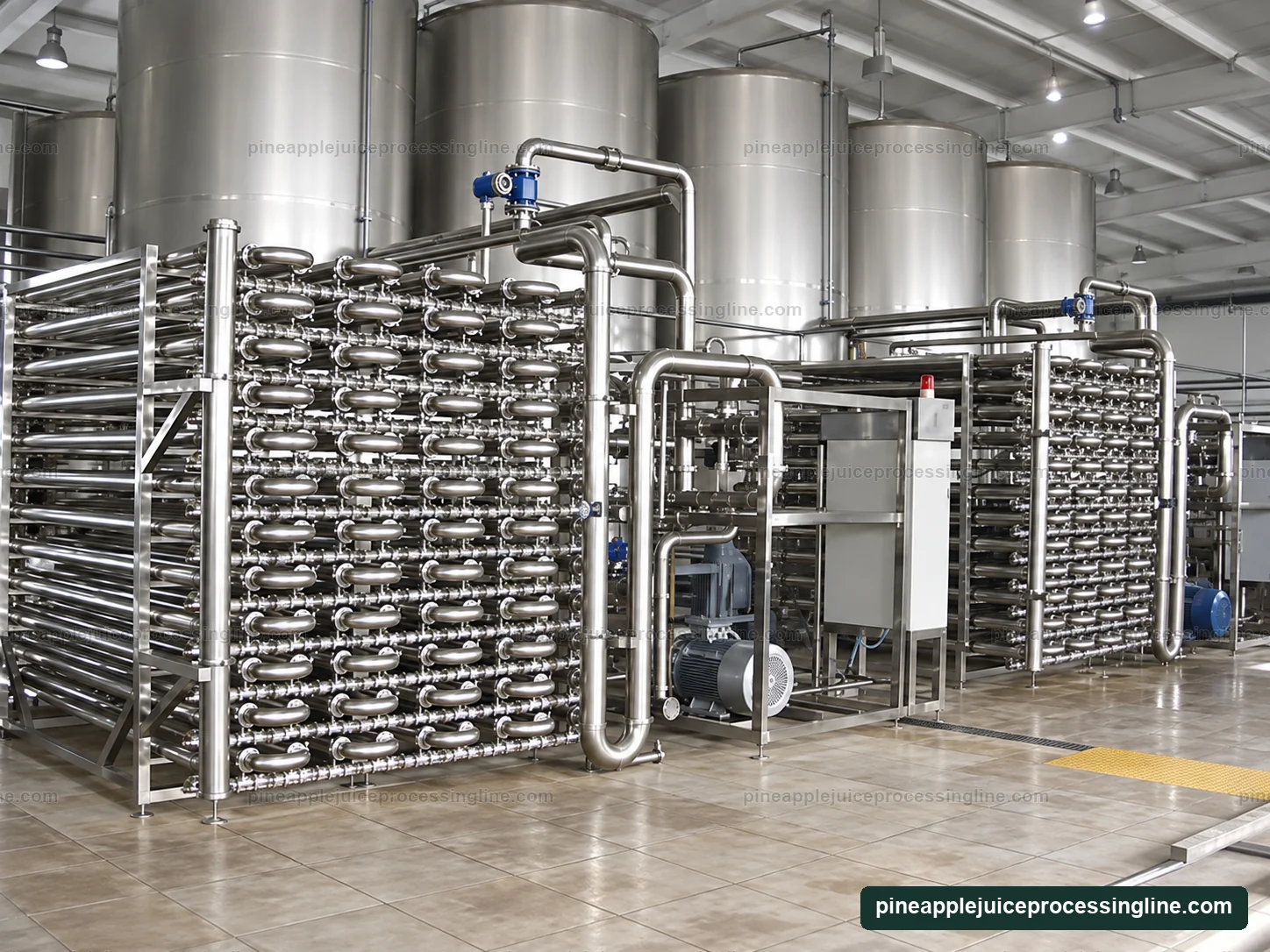
A membrane route separates a permeate stream from retained material. The required clarity and composition are product decisions; membrane area, operating conditions and cleaning procedures follow testing with representative pineapple juice.
Provide a route for the retained stream and access to the membrane circuit. Membrane cutoff, flux, recovery and cleaning frequency must be established for the selected feed and configuration rather than assumed from a photograph.
Keep the clarified product route connected
Clarified juice still needs compatible buffering, product transfer, treatment and packaging. State the product temperature and operating sequence at each connection, including starts, stops and cleaning transitions.
Discuss product trials before committing to a particular performance target. A useful enquiry distinguishes the required product quality from the proposed machine and identifies any existing extraction or treatment equipment.
At this stage
Practical questions
Is a two-stage finisher a membrane system?
No. The two-stage screened machine and the tubular membrane machine use different separation mechanisms and serve different selection tasks.
Can clarification be added to an existing extraction line?
It can be assessed once the extracted stream, available interfaces and product objective are defined. Feed buffering, retained-material handling, utilities and cleaning also need to be included.